
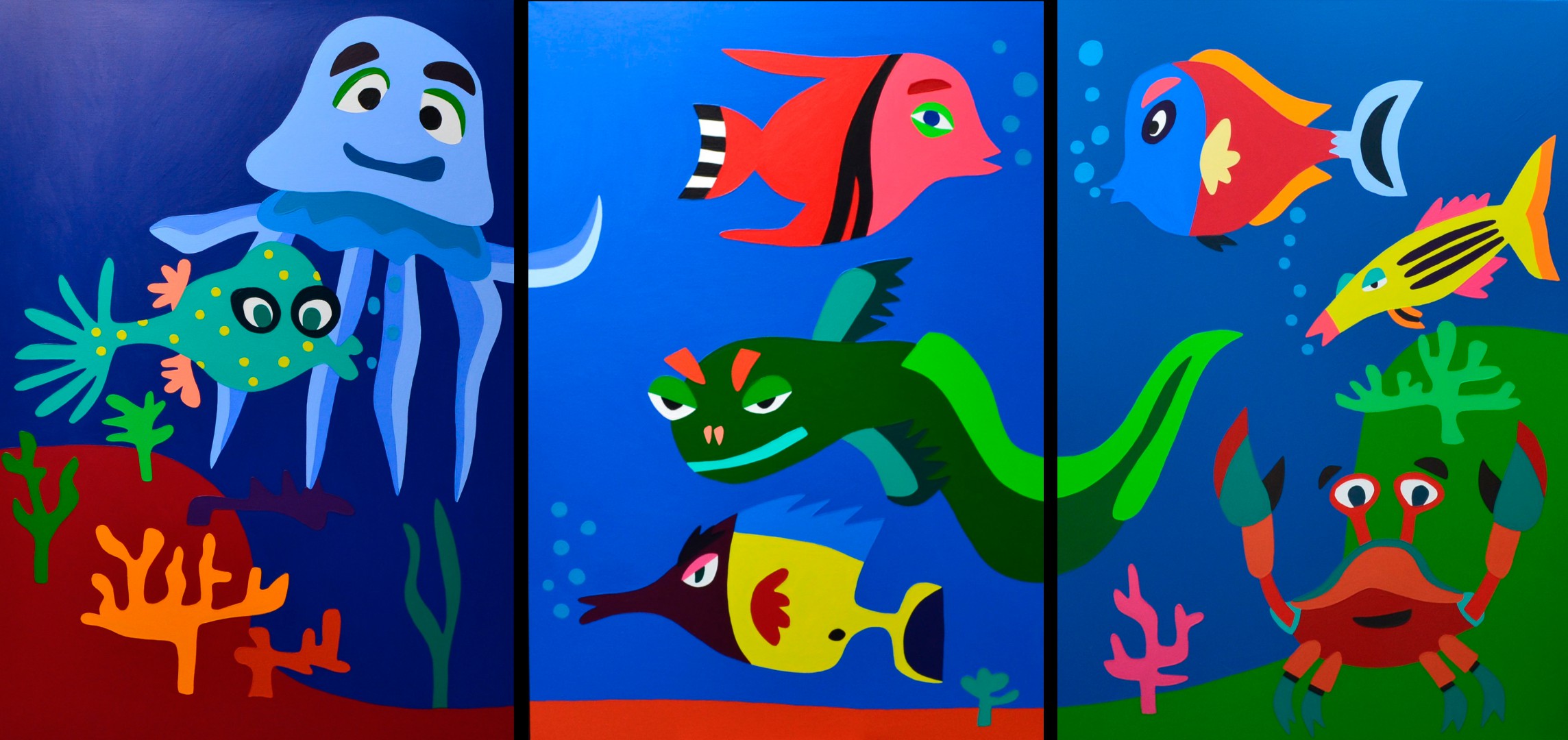
Artwork · Education · Environmental Awareness
This artwork is born as an invitation to rethink our relationship with the sea, to learn through art, and to awaken curiosity, sensitivity, and care for the oceans.
The artist points out:
“It is very important for children to get to know marine species from the oceans, because in addition to understanding their biological role, they can discover their own talents and develop a special love for another living being.”
From his perspective, Gonzalo states:
“Emotional education and the art of a new consciousness can change the course of our relationship with nature and help us reconnect with the oceans.”
The artwork also reminds us that June 1st is World Coral Reefs Day, a relatively recent official proclamation (May 2019), created so that June would serve as the Month of the Oceans, promoting awareness of the real state of marine ecosystems and the need for concrete conservation actions.
“Expressing ourselves is also education.”
What we find in the artwork
In this composition we find: corals, a jellyfish, a crab, a green moray eel, a yellow copper fish, a powder blue surgeonfish, a longnose butterflyfish, a bluestripe snapper, and a Moorish idol.
Each of these species plays an essential role in maintaining the balance of the reef, visually illustrating the interdependence of marine life.
Why coral reefs need our care
Coral reefs are highly vulnerable ecosystems. They are threatened by:
– plastic pollution,
– overfishing,
– rising sea temperatures,
– and ocean acidification, a chemical process caused by the excessive absorption of carbon dioxide, which particularly weakens corals.
Plastics that reach the sea break down into microplastics. Many animals mistake them for food. Understanding this process is key to transforming everyday habits and strengthening environmental education.
“Sea turtles, for example, mistake floating plastic bags for jellyfish, and many become trapped in abandoned fishing nets. These are avoidable situations when there is awareness and responsibility.”
Benefits of coral reefs for life:
– They protect coastlines by reducing the impact of storms and erosion.
– They host enormous biodiversity, from small invertebrates to large marine species.
– They contribute to planetary balance, as oceans are major producers of oxygen and regulators of the climate.
– They sustain livelihoods, especially in coastal communities.
Coral reefs are found along the coasts of more than 100 countries, and nearly half are concentrated in six regions: Indonesia, Australia, the Philippines, the Maldives, Fiji, and Papua New Guinea.
Art, education, and prevention
Educating with the heart, integrating art, and talking about marine species in classrooms is a concrete way to:
– prevent environmental degradation,
– foster values of care and responsibility,
– and reduce the stress suffered by nature.
Art opens questions, awakens emotions, and plants awareness. Caring for coral reefs is caring for life.